The League of Constitutional Voters is a nonpartisan membership organization working to ensure that ALL public offices are decided with a choice on the ballot. We present every candidate to the public on equal terms, and we recruit, train, and encourage citizens — especially young citizens — to stand for office.
Why “Constitutional”
Because the whole design rests on one line of it.
The Constitution and the constitutions of the fifty states set up a system that assumes a choice. Terms end. Seats open. Citizens step forward. Voters decide. Every part of that machine still works — except the part where a citizen steps forward. That part has quietly stopped in most of the country, and nobody is legally required to notice.
We are not constitutional in the sense of having opinions about what the document means. We have none, as an organization, and we never will. We are constitutional in the sense that we do the one job the document assumes somebody is doing: making sure there is a choice on the ballot.
Washington already requires every officeholder to swear an oath to the Constitution of the United States and to the Constitution of the State of Washington. We don’t need to add a pledge on top of an oath. We just need to make sure someone is standing there to take it.
The Preamble
Read at the opening of every Annual Assembly and every chapter chartering. Printed on the back of every membership card. The first words of our Bylaws.
To uphold and defend the Constitution of the United States and the Constitution of the State of Washington by seeing that every office they create is filled by the people's choice; to present every candidate to the public on equal terms; to teach our neighbors how their governments work and how to stand for office; to inculcate a sense of individual obligation to the community, county, state, and nation; to give young citizens real responsibility and the confidence to lead; to hold ourselves absolutely nonpartisan, endorsing no candidate and taking no position; and to keep faith with our members through open books and open doors — we associate ourselves together as the League of Constitutional Voters.
Two phrases — "to uphold and defend the Constitution" and "to inculcate a sense of individual obligation to the community, state and nation" — are adapted with attribution from the Preamble to the Constitution of The American Legion (1919).* ## Uses - First words of the Bylaws. - Read aloud to open the Annual Assembly and every chapter chartering. - Back of the membership card. - mission.html, anchor `#preamble`.
Four pillars
Everything the League does belongs to one of four pillars. Every program, every budget line, and every chapter report is tagged to one. If a proposed activity fits none of them, it does not happen. That rule is what keeps the League from drifting.
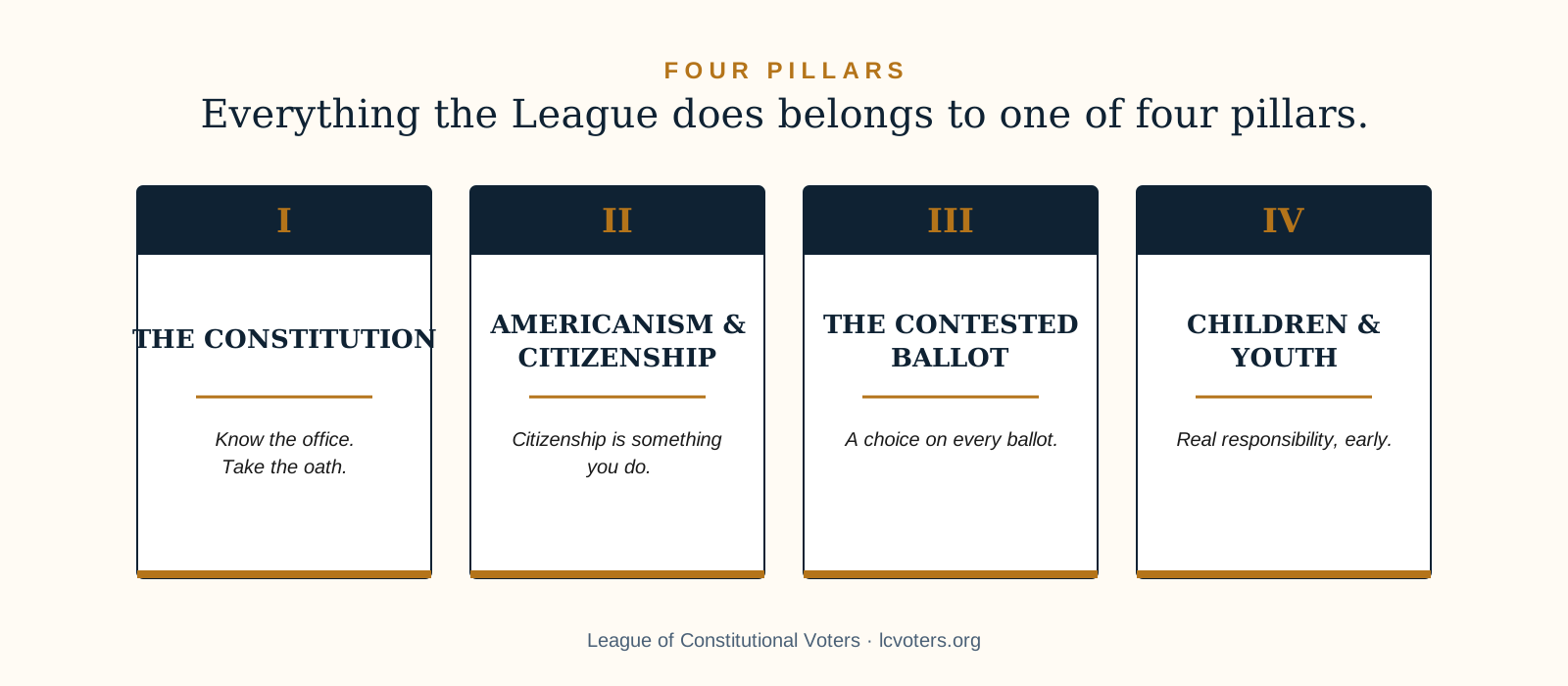
I. The Constitution
We teach citizens how the Constitution of the United States and the Constitution of the State of Washington create the offices on their ballot, what those offices do, and what the oath of office requires. We hold no interpretation of either constitution as an institution, and never will.
Programs: Constitution Day (September 17); “What This Office Does” one-pagers for every local office; the “Who Will Stand?” oration contest; the civics module of Learn to Run.
II. Americanism & Citizenship
Vote. Serve. Show up. Welcome the newly naturalized. We define citizenship by the things citizens do, not by the things they believe.
Programs: nonpartisan voter registration and Future Voter sign-ups at 16 and 17; National Voter Registration Day; new-citizen welcome at naturalization ceremonies; Ballot Check calls; titled volunteer roles; Venue Partners.
III. The Contested Ballot
The reason the League exists. No public office should be decided without a choice on the ballot.
Programs: monthly meet-and-greets; quarterly Learn to Run; the February Empty Ballot List and the filing-week push; voter guides; the Empty Ballot Tour; the June Contested Ballot Report.
IV. Children & Youth
A pipeline from first civics lesson to first candidacy.
Programs: $10 membership and a board seat reserved for someone under 30; Junior participants from 13; Youth County and Youth Capitol; the Founders’ Scholarship; the Empty Ballot Research Project for academic credit; campus chapters.
Youth of the People
Tomorrow’s officials are sitting in today’s classrooms.
Somewhere in a high school classroom this morning there’s a student who will one day sit on a city council. Another will serve as county commissioner, one will be a judge, and someone in that room may raise their hand to take an oath to support and defend the Constitution. They don’t know it yet, and most of the adults around them don’t either.
That’s the problem LC Voters wants to solve.
A Republic Is Only as Young as Its Leaders
Look at who fills the seats on most ballots: school boards, port districts, fire commissions, county offices, the legislature. The candidates are mostly middle-aged or older. Many have served faithfully for years, and they deserve our thanks. But every term ends, every official eventually retires, and a republic that doesn’t prepare the next generation is running on borrowed time.
Too often, people who care about limited government, individual liberty and constitutional principles have treated elections as a defensive fight. They hold the line one cycle at a time, with no plan for who will pick up the work when they set it down. Meanwhile, other ideas about government are recruiting young people early and on purpose: that the state should manage more of our lives, and that the individual matters less than the collective.
You can’t beat an idea by complaining about it. You beat it by training people who can explain a better one, live it and lead with it. That work starts in high school, not at age 45.
The Founders Were Young
It’s easy to picture the founders as gray-haired men in powdered wigs. Many of them were young when they changed the world:
- Alexander Hamilton was about 20 when he joined the fight for independence, and he later co-wrote The Federalist Papers.
- James Madison was 25 in 1776 and 36 when he helped draft the Constitution.
- Edward Rutledge was 26 when he signed the Declaration of Independence.
- Jonathan Dayton was 26 when he signed the Constitution, the youngest to do so.
- The Marquis de Lafayette was 19 when he crossed an ocean to serve in the Continental Army.
The American Republic was built by young people who had been given an education in liberty and a reason to act on it. There’s no reason it can’t be renewed the same way.
What Young People Need: Tools and Motivation
Young people are neither apathetic nor foolish. They are often untrained and uninvited. Nobody has shown them how their town actually works, and nobody has told them their voice counts before they turn 18. LC Voters believes students need two things.
1. The Tools
Constitutional literacy. Know what the Constitution says, what the Bill of Rights protects, and why the separation of powers exists. A citizen who has read the founding documents is hard to mislead.
How local government really works. Who sets your property taxes? Who decides what’s taught in your school? Who approves new roads, parks and permits? Students should be able to name their council members, commissioners and legislators, and know how to contact them.
Public speaking and debate. Leaders persuade. Learn to stand at a podium, make an argument with facts, and respectfully answer someone who disagrees.
Research and discernment. Learn to read a budget, trace a claim back to its source, and tell reporting from opinion.
2. The Motivation
Ownership. This is your country, your county and your town. The decisions made today about debt, taxes, schools and freedom will land on your generation first.
Purpose. Public service is not a career for the connected few. It is the duty and privilege of free citizens, and the Constitution opens its doors to ordinary people.
Mentorship. Every young leader needs someone who has done it before and is willing to open a door.
Where to Start, Starting Now
You don’t have to wait for your 18th birthday to begin.
While you’re in high school:
- Attend a city council, school board or county commission meeting, and sign up to give public comment on an issue you care about.
- Run for student government, and treat it like real office: make promises you can keep, then keep them.
- Look into programs such as the Washington State Legislature’s Page Program, American Legion Boys State and Auxiliary Girls State, and YMCA Youth & Government.
- Ask to shadow a local elected official for a day.
- Join or start a debate club, a constitution study group or a civics club at your school.
- In Washington, 16- and 17-year-olds can sign up in advance as future voters, so do it.
At 18 and beyond:
- Register and vote in every election, including the “small” local ones where a handful of votes decides the outcome.
- Run for precinct committee officer. It’s one of the most accessible elected positions in Washington and a direct way into how candidates are chosen.
- Apply to a city or county advisory board or commission.
- Volunteer on a campaign so you can learn the work from the inside before your name is on the ballot.
A Word to Parents, Grandparents and Current Officials
If you’re reading this and you’re past your school years, the job is yours too. Invite a young person to a meeting. Take your grandchild to the courthouse. Hire a student to help on your campaign. If you hold office, mentor someone who could replace you, and be glad of it. The measure of a public servant is not how long they held the seat. It’s whether they left someone ready to fill it.
Our Commitment
LC Voters is committed to building that bench. We will work with students, families, schools and community leaders to provide:
- Workshop / speaker series on the Constitution and local government,
- Mentorship pairings with current and former officials,
- Student meeting-attendance or public-comment challenge,
- Scholarship, essay contest or youth leadership award.
Contact us at info@lcvoters.com to get involved, bring a program to your school, or volunteer as a mentor.
The Tide Turns With a New Generation
Our constitutional Republic is not self-sustaining. As Benjamin Franklin is reported to have said when asked what kind of government the Convention had created: “A republic, if you can keep it.”
Keeping it has always been the work of each new generation. The officials of 2040 are in high school right now. Let’s make sure they are ready and willing to serve. They are the youth of the people, and the future of the Republic depends on what we give them today.
— League of Constitutional Voters
What we believe as an organization
Exactly three things. This is the entire list.
Every office should have a choice on the ballot.
Not a preselection, but a choice. Two names, minimum, so that the seat is won and not merely assigned.
Every candidate deserves the same room and the same questions.
Whoever they are. Whatever they think. However unlikely they are to win.
Anyone eligible should be able to find out how to run in under an hour, for free.
The information is public. It is also scattered, jargoned, and buried. That is a solvable problem, and solving it is most of our work.